SETTING AN EVANGELISM STRATEGY
FOR A CHURCH PLANT
In this article from the series, ”Lessons Learned in the Cauldron of Church Planting”, Vince shares the most effective evangelism strategy he has used over many years in the church plants he has started.
What is the role of evangelism in the Church?

Generally, in the church context, evangelism tends to be either for a select few die-hards or the exceptional event when a visiting evangelist is in town. It would be an understatement to say that taking the Gospel to secular people is not most Christians’ favourite pastime! Yet everyone will tell you that it’s the primary mission of the Church.
In Pentecostal churches in recent years, the tendency has been to base an evangelism strategy around reaching the homeless and the poor by offering food, clothing and helping to meet other essential needs the underprivileged person might have. The thinking behind the strategy is showing Christian compassion and taking the opportunity to share faith in Christ with those who respond. Now, of course, this work is highly commendable and aligns itself with such well-known church-based welfare agencies as the Salvos, Vinnies, Lifeline, and Anglicare.
My deep concern is that we are content in reaching out to this section of the wider community, but what about all those who are not included in this category? The 2021 Census revealed that, on census night, there were over 122,00 homeless people in Australia. I imagine that this figure would be much higher today. Yet our overall population tops 27 million and all need to be reached with a clear Gospel message.
My approach to effective evangelism
I would like to share with you my approach to this question, which has been the single most successful way each of our church plants has evangelised their communities since 1988.
My approach is based on the principle that a church, whether starting or established, must do the most important thing at the most important time. This means preaching the Gospel message at the church’s main corporate gathering, which in most cases is still Sunday morning.
Please don’t react… but read on!
I’ve had some pushback when I’ve suggested the strategy, hearing comments such as: “Don’t touch our worship service. It’s for us Christians.” That reaction is both understandable and predictable. I’m not suggesting we should change the very nature of our Sunday morning service. I’m suggesting that, from time to time, we have a special “Visitors Service” which has, as its focus, a service that is particularly geared to unbelievers and unchurched people, a new people-friendly service.
If you read on, you will discover an approach that any church can implement whereby the whole congregation is involved in reaching the lost. Does that interest you?
What follows is a presentation of the vision and implementation of a regular church visitors’ service.
VISITORS’ SUNDAY STRATEGY

A Visitors’ Sunday strategy is based on the principle that the most important thing (preaching the Gospel to the lost) must be done at the most important time of a church community (the Sunday service of any church).
This strategy has been the one thing that has allowed us to regularly win new people to Christ in the context of a local church. It also involves the whole church in this mission.
Such a strategy sends out an important message to all the church: collectively, our responsibility is to reach people and preach the Gospel in a meaningful way.
A visitors’ service is geared to the non-initiated. It is not geared to the needs of Christians, though all Christians who love Jesus will rejoice in seeing new people respond to the Gospel message.
The advantages of the Visitors’ Service Strategy

The advantage of a visitors’ service strategy is that it is not an exceptional event.
When visitors come to a Friday or Saturday night meeting, they come to a one-off event. There is no sense of continuing to come again. This would have the same effect if they went to a concert to hear an internationally known singer. It may be a great experience, but it’s totally a one-off!
If we want to build new churches, our evangelistic meetings mustn’t be an exceptional event. Hence the importance of a regular Sunday Visitors’ Service strategy.
The huge plus of the visitors’ service strategy is that it involves the whole church and not just a few motivated Christians who commit to an outreach programme.
Preparation for a Visitors’ Service
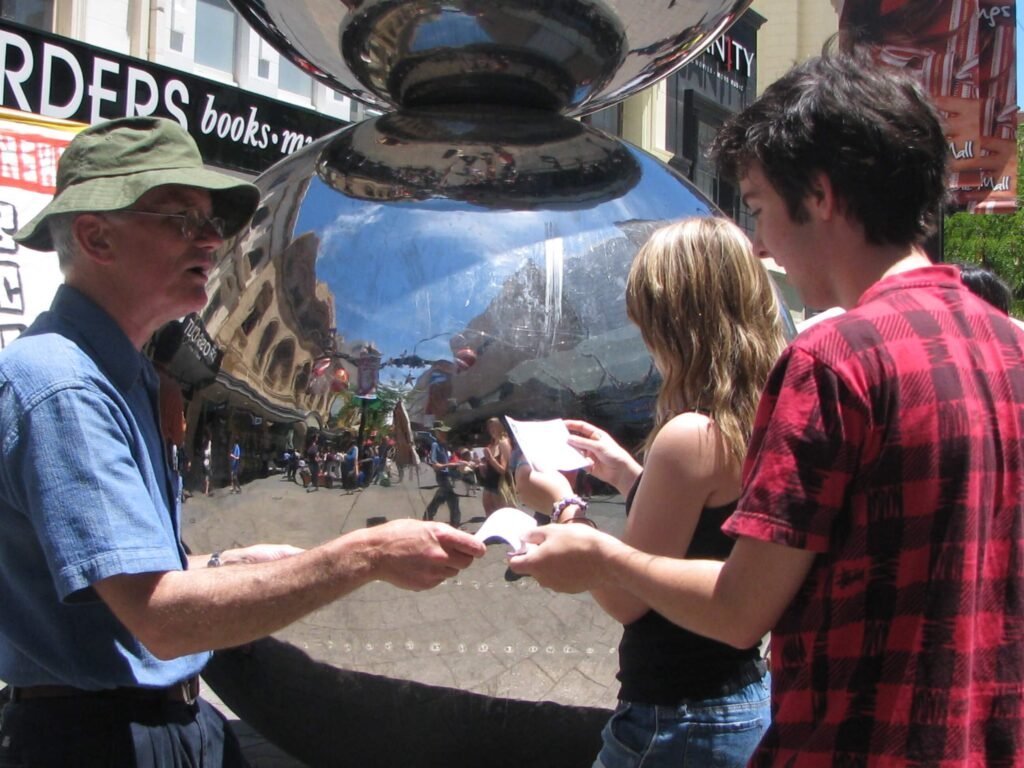
- Produce an invitation that will be distributed to church members the preceding Sunday… eg. 3 per person for personal distribution. Each person can then decide what they’ll do with their flyers. The same invitation can be distributed in letterboxes in the area.
- The theme of the message needs to appear. The only thing that will attract people to the service is a theme that interests them.
Examples of themes that could interest non-Christian people:
– “What you’ve always wanted to know…what lies beyond the grave?”
– “Religions, beliefs, spirituality…what are the differences?”
– “How to no longer be worried about the future”
– “Is it possible to believe without seeing?”
– “The resurrection of Jesus…are there any proofs?”
– “If I could change just one thing about my life…”
– “Why do bad things happen to good people? Is life not unfair?”
– “Are miracles still possible today?”
The Visitors’ Service programme must be streamlined and uncluttered:
- Song service of only 20 minutes – songs of rejoicing in the goodness of God and one song imparting the anointing of God’s presence.
- No communion service.
- Offering as normal – people understand giving to a cause.
- Message: no more than 30-40 minutes.
- Service must not be longer than 1 hr 30 min. Anything longer becomes too long for new people.
- If there’s a testimony, it should be in the format of an interview, not a stand-up testimony.
- No mission reports, no in-house matters, no videos and reduced announcements of the church programme.
An altar call for salvation is vital, but my suggestion is to call them to the front for personal prayer with the whole congregation involved. The congregation needs to savour what God is doing in the lives of those who respond.
For a church which is led by an evangelistic ministry, a monthly visitors’ service strategy could well be implemented. Otherwise, if the lead pastor doesn’t have a strong evangelistic motivation, a Visitors’ Service every six weeks would be more realistic.
Over the years, we have seen many new churches grow with souls won to Christ by adopting the Visitors’ Service strategy.
Why not talk to a leader to see what they think of this approach? It might make a real difference for those you relate to.